Life at Lynch · October 2026 · Recruiting
Career fairs get described as resume collection. The resumes are the least useful part. What makes the drive worth it is a few unhurried hours with students who are deciding what kind of engineer they want to be, and who in most cases have never met anyone who does this work for a living.
This fall we set up at the University of Wisconsin-Platteville and the Milwaukee School of Engineering. The sign on our table says exactly what we are there for: internships, co-ops, and full-time jobs.
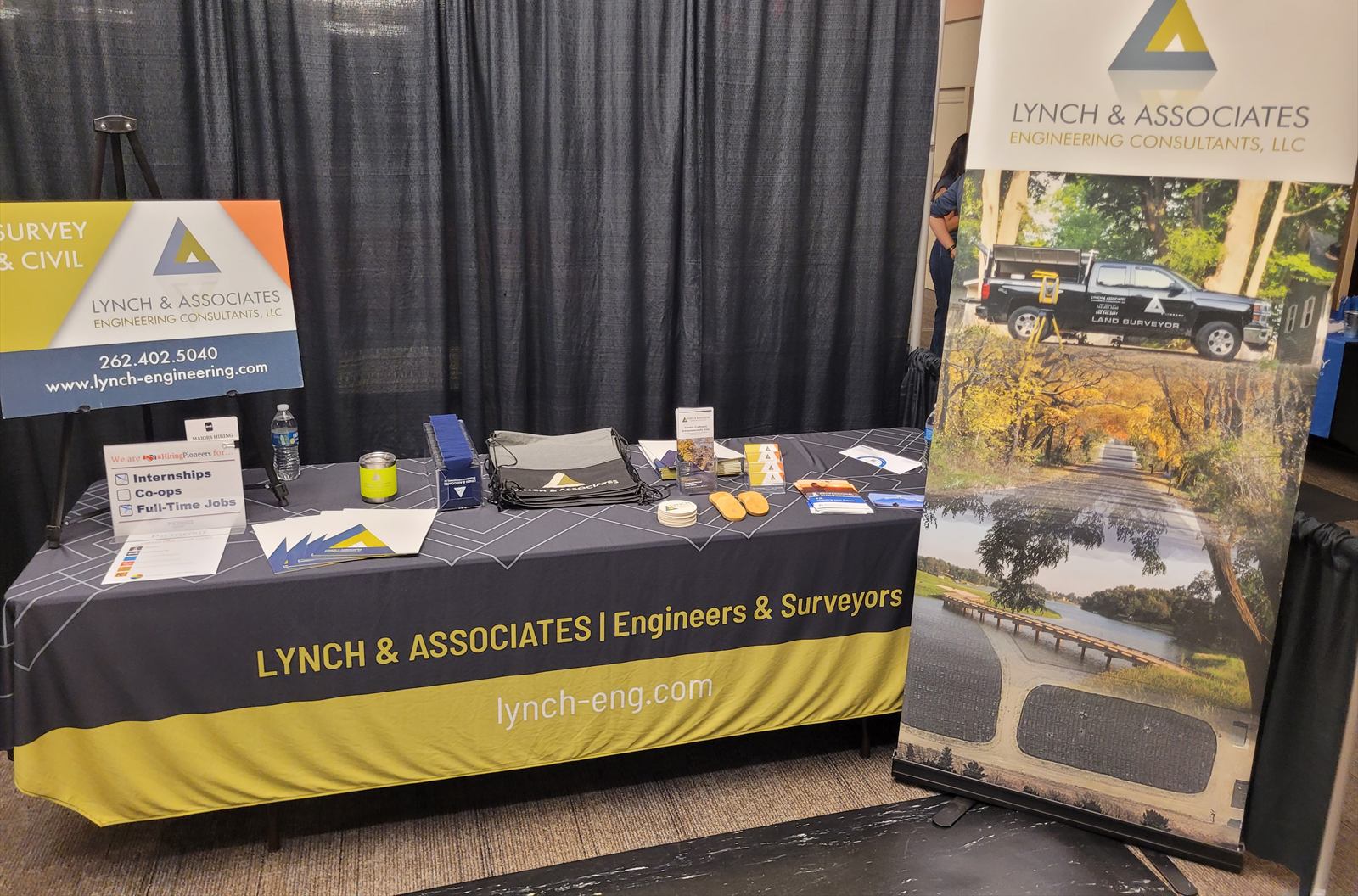
Our booth at a fall 2026 engineering career fair - internships, co-ops and full-time roles.
What students actually ask
Rarely about benefits. They ask what the day looks like - whether you sit at a desk or stand in a ditch, and how often it is both. They ask whether a civil engineer picks a lane at 22 and stays in it, or moves between municipal work, transportation, land development, construction and surveying. At a firm our size, moving between them is the normal case rather than the exception.
They ask what a consulting firm even is, and how it differs from working for a county, a contractor or a state agency. Those are good questions, and they rarely get a straight answer in a lecture hall.
What the first years look like here
A new engineer here works next to people who have been doing this for twenty and thirty years, on projects that are actually being built, with their own work attached to the deliverable. Client meetings come early. So do village board rooms. So does the first time someone asks a question you cannot answer yet, in front of people - which is uncomfortable, and is also how the job gets learned.
A firm our size cannot offer a rotational program with eight stops and a formal cohort. What it offers instead is exposure: less structure, more of the actual work, sooner. That suits some people and not others, and it is better to say so at the table than to discover it in month three.
Why we keep going back
The profession needs students to choose it, and then needs firms willing to spend time on them before they are productive. Internships and entry-level hiring are where that starts, and the firms that skip it are relying on everyone else not to.
We would rather meet someone in their sophomore year and still be working with them a decade later. A career can start with a five-minute conversation at a folding table. That is reason enough to keep showing up.
What We Recruit For
Engineering and survey work alongside the people doing it, not a seat in a corner.
Longer placements for students whose programs run co-op terms.
Entry-level engineering and survey positions in Burlington and New Berlin.